Heat, Hydration, and Electrolytes

Justin Kauffman • July 25, 2022
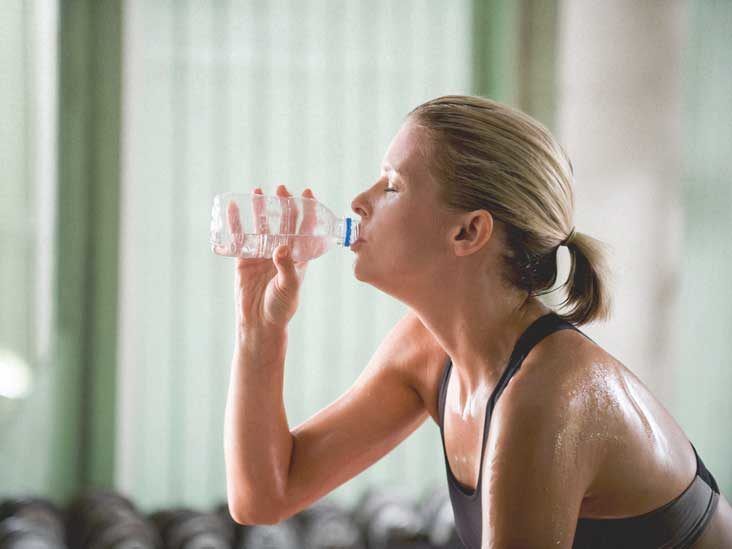
A woman is drinking water from a bottle in a gym.

Sweat evaporates off our skin which allows for heat loss and cooling. However, when we sweat, we also lose water and electrolytes (i.e., “salts” such as sodium, chloride, potassium). Drinking enough water and having enough electrolytes is necessary for our bodies to function properly.  We keep hearing about this massive heat wave hitting the US.  Although, it isn’t substantially hotter than normal, it is still important to keep our hydration and electrolyte levels in check.  

Heat exhaustion occurs when a person exercises and works in a hot environment and the body cannot cool itself adequately. Dehydration occurs with water loss from excessive sweating, which causes muscle cramps, weakness, and nausea and vomiting. This makes it difficult to drink enough fluid to replenish the body’s water supply, and the lack of body water impairs further sweating, evaporation and cooling. Relative humidity is an important factor in developing heat exhaustion. If the humidity is too high, sweat on the skin cannot evaporate into the surrounding air and body temperature cooling fails. – MedicineNet

Some major sign may includes: salt cravings, extreme fatigue, loss of appetite, extreme thirst during and after workouts, mild headache, and then finally vomiting and dizziness. 

Livestrong.com provides a great explanation:

Electrolytes play an important role in the natural homeostasis of the body by maintaining a stable internal environment. They help coordinate muscle contractions, heart function and the conductivity of electric signals in the nervous system. Normally the kidney is the organ that regulates fluid absorption and excretion in order to preserve a narrow electrolyte balance, but when the level of electrolytes becomes too high or too low, an imbalance can occur. Sodium, potassium and calcium are usually the elements most likely to suffer from an electrolyte imbalance.

An electrolyte imbalance is caused by a change in the amount of electrolytes in your body. There are many reasons why these levels might change, including a poor diet, medicines, and kidney problems. Athletes, or at least anyone who exercises on a regular basis, must be acutely aware of an electrolyte imbalance because of the minerals that may escape from sweat, especially during hot days. Sweating is important for maintaining body temperature, but a few grams of electrolytes are lost for every liter of sweat.

So, what can you do to prevent heat exhaustion?

We need to make sure we hydrate properly but just water isn’t going to suffice.  We will need to include some electrolytes.  These can be found in coconut water, gatorade, or electrolytes powder.  My favorite is LMNT powder.  I get it on Amazon. 

MORE RECENT POSTS

By Frank Hurtado September 23, 2025
CrossFit is built on three core modalities: gymnastics, monostructural movements, and weightlifting . Each plays a unique role in developing well-rounded fitness: Gymnastics: bodyweight control and coordination (pull-ups, double unders, handstand push-ups). Monostructural: cardio and endurance (running, rowing, biking). Weightlifting: raw strength and power (snatches, squats, cleans, deadlifts). At RegenX Fitness, we structure our programming in 4-week cycles. During each cycle, we emphasize specific movements within every modality. For example, one cycle may focus heavily on snatches, back squats, or strict handstand push-ups while weaving in cardio pieces to build conditioning. We also program with different workout formats to create varied stimuli: AMRAPs (As Many Rounds/Reps As Possible) : Build endurance and mental toughness while encouraging athletes to pace themselves. EMOMs (Every Minute On the Minute) : Excellent for skill building, reinforcing technique under fatigue, and maintaining consistency. For Time Workouts: Develop speed and intensity, pushing athletes to complete a task as efficiently as possible. Within each of these formats, we vary time domains, each of which taps into a different energy pathway in the body: Short (0–2 minutes): Targets the ATP-PC system — raw power, explosive strength, sprint capacity. Moderate (2–10 minutes) : Engages the glycolytic system — high-intensity efforts that build stamina and grit. Long (10+ minutes): Relies on the oxidative system — endurance, pacing, and aerobic efficiency. By training across all these pathways, our athletes build the ability to perform at high levels whether it’s a short burst, a mid-range grind, or a long test of endurance. Another key feature of our programming is how we pair strength days (bench press, deadlifts, squats) with accessory work. While the big lifts train major muscle groups, the accessory movements target stabilizers and smaller muscles. This balance builds stronger joints, prevents imbalances, and enhances overall performance. This isn’t just random mixing—it’s a strategic, progressive approach designed to help members get stronger, faster, and more resilient over time. -Frank Hurtado
By Justin Kauffman January 10, 2025
The body content of your post goes here. To edit this text, click on it and delete this default text and start typing your own or paste your own from a different source.
A stack of gingerbread cookies with a red ribbon on a table with christmas decorations.
By Justin Kauffman December 11, 2022
Here’s the scenario: You get busy during the holidays. Really busy. You’re running around everywhere, you’re hosting relatives and friends, you’ve got all sorts of social commitments, and the kids’ schedules are packed with recitals and games. So you skip a workout. Then another. All of a sudden, it’s been a week since you hit […] The post Remember that something is always better than nothing. appeared first on Regenx Fitness and Nutrition.
More Posts